


👋 Ciao, I'm Giulia Blocal, your street art insider. This is Beyond the Walls, a monthly deep dive into street art, graffiti, off-the-beaten-path travel, and a bit of my life in between.
This month’s editorial was sparked by the graffiti film “The Art of Disobedience”, created by and about Rome’s graffiti king GECO, a documentary currently touring cinemas across Italy and Europe. The film serves as a starting point for a reflection on the ethos of graffiti, what has always fascinated me about this world, and what we can learn from it. You’ll find the trailer below, in case (though unlikely) you’ve never come across GECO’s name on a wall.
But first, a few updates on my life and the BLocal project.
Let’s jump in!
Ciao,
How are things with you?
This month I’m writing from Civitacampomarano, the semi-abandoned village in Southern Italy where I return each June to handle communications for CVTà Street Fest, the street art festival curated by Alice Pasquini.
The festival is in full swing: Andy Smith from Portishead is set to play in just a few hours, and I’m still processing the whirlwind of emotions from a week spent with some truly genuine street artists. It’s too soon to put it all into words but, don’t worry, I’ll share more about this year’s edition very soon.
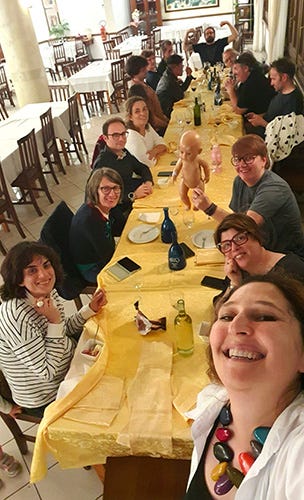
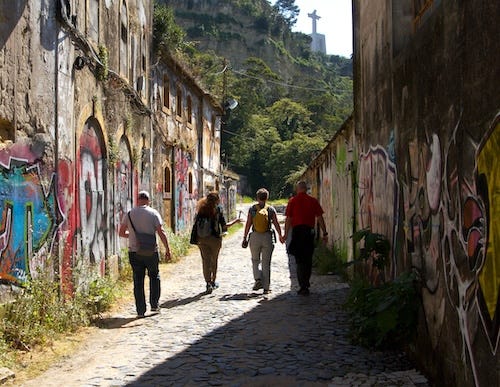
Meanwhile, I’m finally ready to put into words all the emotions stirred by our Lisbon trip. Roaming across the city with those of you who joined me on this research journey for my upcoming book on Lisbon’s street art was undoubtedly the highlight of the month.
As usual during my street art trips, what makes them truly special isn’t just the street art we uncover, it’s the chance to explore it together. Walking side by side, chatting between stops, and seeing the city through your eyes too... I love stepping away from the screen to meet in real life. These encounters always remind me why I began sharing my travels in the first place: to spark a dialogue, not just tell a story.
Speaking of our book series As Seen on the Streets of…—big news! 🥳 Last week, we sent all the materials (texts and photos) to the graphic designer, who has officially started working on the London book.
I can’t wait to give you a sneak peek!
I’m especially excited about this one because it really feels like a step forward: we took everything we learned from the Paris book (learning by doing, as always) and applied it here to make something even stronger. We’ve also picked up a few lessons on the self-publishing side, so fingers crossed this one will run more smoothly and hit the shelves sometime this summer.
And of course, you’ll be the first to know!
Until next month,
Giulia
ps. Whether my London Street Art Book will be out by then or still in the works, we're planning a 5-day exploration of London later this summer, from August 8 to 12. The program is still in progress, but if you're thinking of joining, drop me a message and I'll keep you posted on all the details. ✌️
📚 Updates on my book As Seen on the Streets of Paris
The book has found its Paris home at Le Grand Jeu, a fantastic independent bookshop in the 11th arrondissement dedicated entirely to urban cultures.
Grab your copy directly from Christian Omodeo—graffiti lovers' favorite bookseller—and start exploring right away, with no shipping delays. Le Grand Jeu is also featured in the book, as it’s a must-visit for anyone into graffiti and street art.
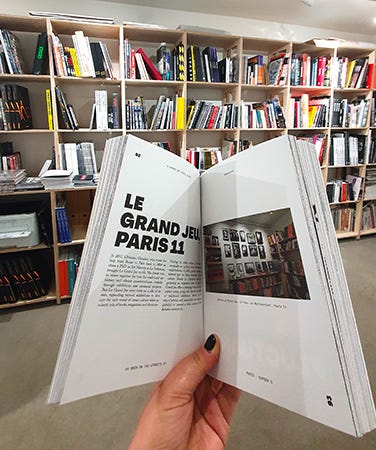
Not in Paris? You can still order it from the bookshop’s website, just click the button below, or send them an email if you don’t see it in stock.
GECO and The Art of Disobedience.
GECO isn’t a “styler”—the kind of graffiti writer obsessed with the typography of letters, their curves, shadows, and colors. GECO is a “bomber”: his focus is on scale, repetition, and visibility. He writes to be seen, and to be seen often.
By the time he began hitting the streets, Rome’s walls were already covered, so he aimed higher, quite literally. GECO climbed to rooftops, tagging surfaces visible to anyone navigating the city below. His signature wasn’t in complex lettering, but in sheer ubiquity. His bold, blocky, “blockbuster” tag appeared everywhere, over and over, until it became something like a logo, an unofficial emblem of urban persistence.
GECO approaches graffiti with a strategy not unlike that of an advertising campaign. His name is everywhere and it’s easy to read, two qualities that make it stand out from most graffiti, which often remains indecipherable to those outside the scene.

That clarity and ubiquity turned his name into something familiar, even among those who know nothing about the graffiti world. His work isn’t just a code for insiders; it crosses over, drawing in outsiders who might otherwise ignore or dismiss tags on a wall. In that sense, GECO’s tag functions like a personal logo: bold, direct, and repeated so often that it sparks curiosity and fascination beyond the graffiti community.
Comparing GECO’s tag to a logo is no coincidence. After all, graffiti coexists in the public space alongside billboards and commercial advertising. And while graffiti tags may resemble logos in their repetition and visibility (advertising the writer, in a way) their purpose isn’t to sell a product. Instead, they assert presence. They claim space.
By occupying surfaces usually reserved for commercial messages, graffiti suggests something else entirely: the right to self-expression, the refusal to remain invisible. In that sense, GECO’s work doesn’t sell a brand; it promotes the idea that anyone can leave a mark, even in a cityscape dominated by corporate voices.
A Political Act, or just the urge to be seen?
Reclaiming spaces dominated by advertising is, in my view, one of the ways graffiti becomes political.
However, for most of the writers I’ve interviewed over 14 years of running the BLocal blog + writing about graffiti for magazines, galleries, and museums, writing their name isn’t about making a political statement. It’s an urge, a necessity, a release, even an addiction. It’s their way of saying I exist in a city that renders people anonymous.
In graffiti culture, this act is known as “getting up”: a term that refers to the practice of tagging frequently, in as many places as possible, to achieve visibility and recognition. It’s a measure of success; how much you’ve been seen, how widely your name travels through the urban landscape.
But getting up is more than just exposure; it’s about standing out from the crowd, breaking through anonymity. It’s a call to be noticed, to assert individuality, to leave a trace.
In a city that overlooks you, getting up becomes a way to mark your existence with intention and defiance.
To be yourself, to show the world that you exist, to claim space in the city, you don’t need anyone’s permission. Graffiti doesn’t ask. It disobeys. And disobedience is political. It’s a challenge to authority, a gesture that creates tension, especially for those who witness it without understanding it.
In this sense, graffiti is a quiet rebellion. It doesn’t necessarily aim to spark systemic change, but it disrupts the social order in subtle, persistent ways. These everyday acts of defiance might seem inconsequential on a global scale, yet for those who engage in them, they offer a sense of power and presence often denied elsewhere.1
Getting up is not about making a revolution—it’s about carving out space, asserting agency, and resisting invisibility.
Much like the now popular idea of “quiet quitting” (the choice to do only what one’s job contract requires, as a silent form of resistance against burnout and the hyper-demanding logic of corporate culture) graffiti challenges the urban order not through overt confrontation, but through quiet defiance. Where labour strikes aim to shut down a system, quiet quitting subverts it from within. In the same way, tagging stands in contrast to revolution: it doesn’t seek to overturn the system all at once, but to insert a name, a presence, a voice into a landscape that tries to erase individuality.
Writers who get up are refusing to be silenced. Their tags say I’m here, even when the system would rather they weren’t. Through graffiti, they slip through the cracks of social control, resisting the forces that seek to exploit, surveil, and erase them.
In a city that often reduces people to roles, numbers, or consumers, tagging is a refusal to disappear, a demand to be seen on one’s own terms.
The Graffiti Ethos and the lessons it holds for us.
What fascinates me most about graffiti isn’t just the “art of disobedience,” but something deeper: its purity. That purity isn’t only about painting illegally, though rejecting the need for permission is part of it. It’s about being untouched by the systems that seek to define, approve, and exploit creative expression. Graffiti answers to no one. It isn’t shaped by markets, institutions, or audiences.
Writers don’t do it for money, or even for the “artist” status. “We’re not artists, we’re writers,” they often say, reminding us that they’re not chasing recognition from the art world or the public.
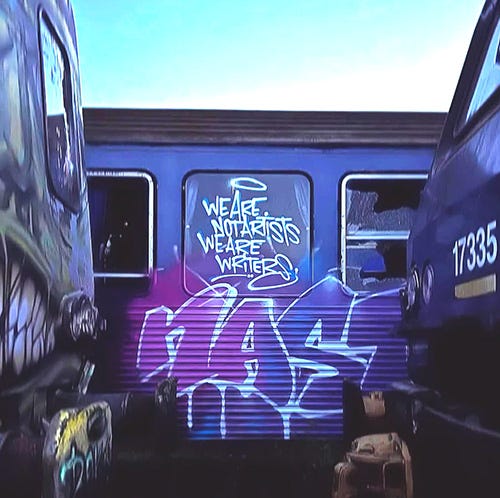
The respect they seek comes from within the culture, from their peers, not from outsiders they don’t respect, and certainly not from society at large.
Graffiti is built on an inner code. It isn’t meant to be understood by everyone, and it’s definitely not meant to please everyone. In fact, many writers take pride in being disliked by a society they never tried to appeal to in the first place. They want the respect of those whose respect matters to them, and ignore the rest.
In a world driven by visibility, likes, and constant approval, the refusal to seek validation becomes, in my view, a radical act. Simply being yourself—without tailoring your expression to fit the logic of algorithms and applause—has become a political gesture in its own right.
Another aspect of graffiti that fascinates me (and probably the one I’ve emphasized most in my writing over the past 14 years, given my focus on cities and public space) is how it proposes a different way of moving through the urban landscape.
Writers engage with the city actively, not passively. They interact with its layers, its margins, its invisible infrastructure. While most people experience public space in the way it was designed (following signs, routines, and predetermined paths) writers carve out their own trajectories. There’s rebellion in that refusal to follow the flow, but also a heightened awareness: where most see a single route, writers see a multitude.
Take the metro system, for example. For the average commuter, the station platform is the only part of it that exists. For writers, the metro is a vast, complex network made of tunnels, service corridors, and darkened yards. They slip through manholes, drop into the guts of the city, explore the forbidden.
Writers paint spaces that people don’t even realise are there. These places go unnoticed, until they’re written on. Graffiti brings them into focus. It interrupts invisibility and reclaims attention for parts of the city most have learned to ignore, the so-called non-places: spaces abandoned, overlooked, or rendered invisible by urban planning.
This way of engaging with the city invites us to shift our perspective. To look beyond the obvious, beyond the well-lit paths and polished surfaces. Searching for graffiti means scanning the edges, the overlooked corners, the in-between spaces. It alters how we navigate the urban environment -not just in terms of where we look, but in how we interpret what we see.
By directing our gaze toward the non-places of our cities, graffiti reveals that these places still exist. They’ve lost their function in the commercial system, but not their presence. They remind us that cities aren’t just made of storefronts and landmarks, but also of all the spaces that resist categorisation, the ones that remain stubbornly outside the logic of consumption.
Graffiti offers a different way of being in the city. Writers like GECO remind us that there are still ways to assert individuality in spaces designed for uniformity. They show us that another city exists beneath the one we’re told to see, shaped by overlooked corners, unofficial paths, places with nothing to sell us, and quiet gestures that challenge how public space is expected to be used.
And once you start noticing it, it’s hard to look away.
✍️ New on the blog!
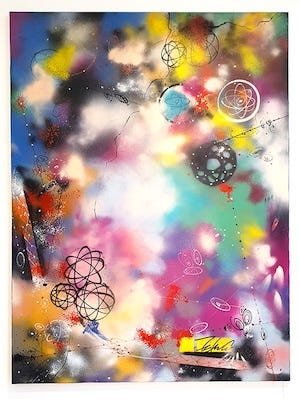
Futura2000 in Paris: Graffiti Pioneer at La Fab
This retrospective goes beyond tracing Futura2000’s evolution, it pulls you into his world. From bold canvases to global collaborations, the show captures how Futura2000 redefined graffiti as a deeply personal, abstract, and boundary-breaking art form. The show is on until October 19th, let me know if you go visit!
See You at WOOL, Portugal’s long-leading Street Art Festival!
WOOL Festival 2025 will take place from 21 to 29 June, marking its 12th edition. Over more than a decade, WOOL has shaped a distinctive voice within the European street art landscape, not only through impressive murals, but through a grounded, thoughtful engagement with territory.
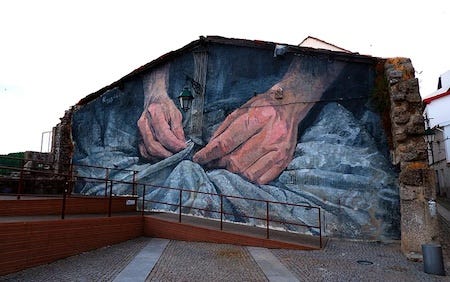
After last year’s brief yet captivating stop in Covilhã, I’m heading back to WOOL Festival, this time for the whole experience. I’ll be there throughout the festival week, watching murals come to life day by day, joining guided walks and talks, attending live concerts and film screenings, and even popping up on the festival’s social media channels to share impressions, conversations, and scenes from the field.
Between CVTà Street Fest and WOOL Festival, I’m also joining the team of Gulìa Urbana, a traveling street art festival that brings contemporary muralism to villages across Calabria, in Southern Italy. I’m currently working on the edition taking place in Diamante, a coastal town known as La Città dei Murales, from June 10th to 17th.
Diamante’s mural tradition began in 1981, long before the rise of neo-muralism linked to New York’s graffiti and street art scenes. In this setting of historical muralism, the team of Gulìa Urbana is bringing in contemporary urban artists, and I can’t wait to see what bold contrasts and unexpected conversations will unfold on Diamante’s storied walls. 🤩
🔁 Updated
Lisbon Street Art: From Addfuel to Vhils (what a bummer I couldn’t find the Z!)
aka my 10-year-old Lisbon Street Art Travel Guide (and its matching Google Map) just got a major update. Have a look!
I rely on the support of readers like you to keep creating genuine and informative content. If you value my work and would like to see more of it, please consider making a donation to support my writing and my editorial project BLocal.
You can Buy me Pizzas, Donate via Paypal, or become a Paid Subscriber.
You can also buy my book, As Seen on the Street of Paris, “like” my newsletters by tapping the ❤️, share them on Substack Notes or other social media, and forward this email to anyone you like.
The idea of getting up as oppositional agency has been first explored in Andrea Baldini’s paper “The Graffiti-Game and the Ubiquity of Resistance” (2024) on GSA - Graffiti and Street Art Scientific Journal - Vol 2, Num 1.
Giulia, thanks a ton for the amazing article. I never thought that graffiti makes our city areas wilder. But when I read about, it was so obvious!
Cheers from Japan!