


👋 Ciao, I’m Giulia Blocal, your street art insider. This is Beyond the Walls, a monthly deep dive into street art, graffiti, off-the-beaten-path travel, and a bit of my life in between.
This month’s editorial grows directly out of a panel I moderated at the Yardworks Festival in Glasgow, focused on legality, artistic freedom, and the contradictions surrounding legal walls within graffiti and street art culture.
But first, a few updates on my life and the BLocal project.
Let’s jump in!
Ciao,
How are you?
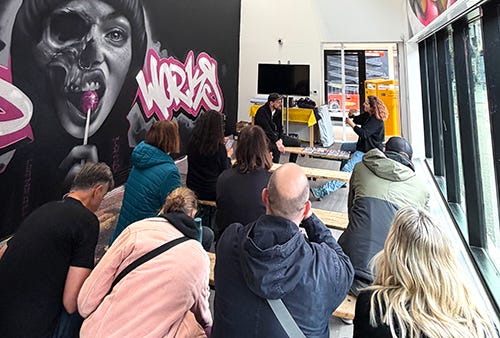
I’ve just returned from the UK book tour, which saw me bringing our independent, self-published street art book As Seen on the Streets of London to four different cities over six weeks, although at some point it genuinely felt like it would never end. 😅
I want these monthly check-ins to stay honest, a real behind the scenes of what my work and my life often look like.
And honestly, this past month left me more frustrated than inspired.
I had projected a lot of hope onto this tour, not only financially but emotionally too, because I thought the festivals hosting the talks and launches would help create momentum around the book, help new people discover it, and give a little more visibility to a project that has been built entirely independently over the course of two years. Instead, most of the time, it felt like pouring an enormous amount of energy into something while barely seeing it move.
After weeks on the road, I came home having sold far fewer books than I had hoped for, and I found myself struggling with a feeling that I imagine many independent creatives know very well: the exhaustion of constantly giving your all to projects you deeply believe in while trying not to let the lack of tangible results slowly erode your motivation.
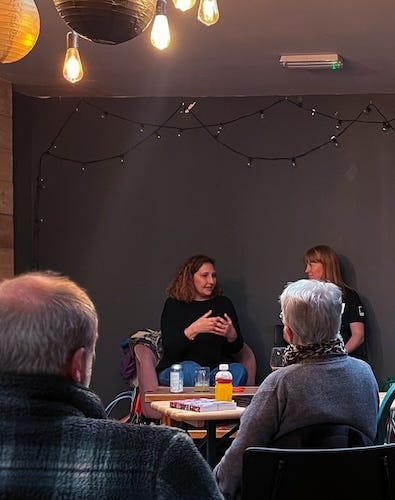
At the same time, I don’t want this reflection to erase the genuinely beautiful moments this tour also gave me, because meeting readers in real life, beyond the screens, remains one of the most rewarding parts of all this, and some of the most meaningful moments of this past month came precisely from those encounters after talks, or around street art festivals.
I also got to reconnect with artists, photographers, writers, organizers, and friends scattered across this chaotic family that the street art scene somehow becomes over time, spread between cities, festivals, temporary reunions, and people constantly crossing paths again in unexpected places.
Still, I’d be lying if I said I immediately bounced back from it all full of fresh energy, especially because the moment one tour ends, many other projects are already waiting, and I’m now supposed to dive straight into the Lisbon book and the next phase of this ongoing series while still trying to shake off a little of the disappointment left by this past month. 😓
So, back R(h)ome, it is indeed time to fully return to the Lisbon book, which is still very far from being finished, and which currently occupies most of my days between (still!!! 😩) chasing artists across different countries to get image release forms signed, working on the collage for the paperback cover, editing texts, and trying to bring some order to a project that, despite months of intense work behind it already, still feels very much stuck in that chaotic middle stage where the finish line remains difficult to even visualize.
At the same time, life outside our “As Seen on the Streets of…” book series somehow kept accelerating too, although this is simply what happens during peak festival season, when emails, projects, invitations, deadlines, and cities all begin collapsing into one another.
Over the past few weeks, I’ve been running the communication for CVTà Street Fest, which this year is growing into something much bigger and more ambitious than before, as we are not only launching a book and opening an art gallery, but also transforming the festival into a more permanent art residency program. I’ll share more thoughts about what this shift actually means in next month’s newsletter, because it says a lot about how I see the future of street art festivals evolving, but if you are joining the big opening party where Massive Attack’s Daddy G will be playing, meet me at the front left speaker on June 27th. 😏
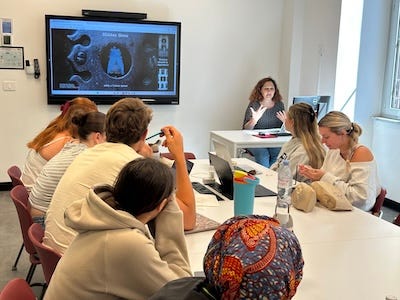
In between all this, I’ve also been writing about Nuart Festival for a couple of art publications (links at the bottom of this newsletter), speaking at Rome’s American University about over-tourism and the ways cities might respond to it and, because apparently none of this was enough already, we are now also preparing for a couple of urban art book fairs in Italy (Assedio in Modena and Tabula Rasa in Civitanova Marche), which means the house is currently a chaos of book stocks, packaging materials, tablecloths, paper bags, and more bits and bobs. 😅
Until next month,
Giulia
ps. I somehow forgot to mention that I’m also heading back to WOOL, Portugal’s first urban art festival, which is turning 15 this year. More details on the festival program below.
See you on the road!
✈️ Travel with me!
You love hunting for street art in the farthest corners of a city, but every trip turns into a negotiation with someone who's already tired after the second mural?
With us, things work differently.
Join us in Berlin, from August 27 to 31
The trip is part of the research for the upcoming Berlin book. I’ll guide you through the city, while Paolo photographs it for the next volume of the As Seen on the Streets of… series. By joining this crowdfunding trip, you become part of the process and will receive a copy of the book once it’s published.
📤 Reply to this email if you’d like to join!
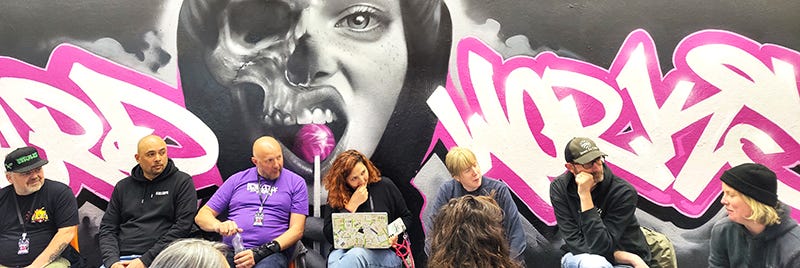
This month’s editorial grows directly out of a panel I recently moderated at the Yardworks Festival in Glasgow, focused on legality, artistic freedom, and the contradictions surrounding legal walls within graffiti and street art culture.
I have published the full panel transcript on the blog for those who want to read the complete conversation, while here I continue to unpack the ideas, tensions, and provocations that remained unresolved during the discussion, for lack of time.
The Problem with Legal Walls.
What happens when a culture born from direct, unauthorized interaction with the city becomes a curated cultural infrastructure?
While preparing for the panel, I knew that this was the question I actually cared about the most. Yet, like often happens during public discussions, we never fully arrived there. We spoke about legal walls, mural festivals, artistic freedom, institutional compromises, and creative autonomy, but the deeper contradiction remained mostly beneath the surface.
Because the real question is not whether legal walls are “good” or “bad,” but what happens when a cultural practice born from a spontaneous and direct negotiation with urban space slowly transforms into an organized cultural infrastructure made of permits, sponsors, public funding, and municipal approvals.
The paradox is that, while mural festivals are often presented as a celebration of street art culture, the more institutionalized and production-heavy they become, the more selective they inevitably are, ultimately contradicting the openness and accessibility that once stood at the core of the street art movement.
The more resources a festival needs in order to exist, the more stakeholders become involved in deciding who gets to paint, what kind of work is acceptable, and what kind of aesthetics are considered valuable.
Moreover, the obsession with monumentality has not only transformed the visual language of street art, but also narrowed the psychological perception of who belongs in that space.
Today, many people no longer imagine themselves painting a wall unless they possess extraordinary technical skills, a polished portfolio, institutional legitimacy, or access to festival networks, even though graffiti and street art were originally born precisely as direct and accessible forms of interaction with the city, practices that existed outside institutional frameworks rather than being filtered through them.
At the same time, however, I don’t want to romanticize illegality entirely, because the risks embedded within the practice have historically excluded many people as well. The possibility of arrest, fines, or police violence inevitably affects people differently, often discouraging those who are already more vulnerable or marginalized, including people of colour, while the necessity of moving through the city at night, frequently in isolated spaces, has also kept many women away from certain forms of graffiti and unsanctioned street art altogether.
Legal walls and mural festivals have undeniably opened the field to artists who may never have entered the culture otherwise, and this is something that should absolutely be acknowledged. The problem begins when the desire to make street art more publicly acceptable also starts flattening its visual language and its complexity.
One of the most revealing moments during the panel came when Izzie Hoskins spoke about the public backlash received after replacing a figurative mural portraying Jimi Hendrix with a much more abstract intervention by graffiti writers Taps and Moses, when many people suddenly felt compelled to complain after being confronted with a work they could not immediately decode aesthetically.
This is exactly the same dynamic I witnessed in Rotterdam during the All Caps Festival, when Eneri painted a large-scale pixação piece on a prominent wall, triggering intense public reactions and debates around what is considered acceptable or even recognizable as art within the public sphere. Ironically, the curator of that festival, Daniel Claessens, was sitting on the panel in Glasgow, but unfortunately we did not have enough time to fully unpack that topic, despite it touching the core of the entire discussion. I actually wrote about this episode in a previous newsletter because I believe it says a lot about the current state of street art culture.

What these reactions reveal is that the public often embraces street art only as long as it remains visually reassuring, decorative, and Instagrammable. Murals are celebrated when they beautify and/or provide instantly recognizable cultural references, but the moment an artwork becomes coded, politically uncomfortable, or simply difficult to interpret, its legitimacy is questioned again.
In many ways, institutions have helped normalize street art aesthetically without necessarily embracing its deeper cultural logic. The public has learned to appreciate murals, but not always how to read them critically. This is also why I increasingly believe that education should become a much more central part of festivals and public art programs, not in the sense of making the work more accessible by simplifying it, but rather by giving audiences the tools to engage with complexity, ambiguity, subcultural references, and forms of visual expression that do not immediately explain themselves.
Most of the work I do actually revolves around this exact process: accompanying audiences, residents, and local communities beyond the disneyfication of street art, helping create a wider understanding of why certain works matter even when they are uncomfortable or anti-decorative. Because if public art only becomes acceptable when it behaves politely, reassures viewers, and fits neatly within the visual language of urban branding, then we are no longer talking about a culture capable of challenging public space, but simply about another form of city marketing.
More broadly, I believe the problem is not that street art has entered institutions, municipalities, museums, or cultural programming. After more than fifty years, it would be unrealistic, and honestly reductive, to imagine graffiti and street art remaining frozen in a purely underground dimension forever. The problem begins when the culture is expected to reshape itself entirely around the conservative logic of institutions, instead of institutions evolving enough to support a form of expression that is, by nature, contradictory, rebel, territorial, and at times uncomfortable.
What is increasingly being regulated today is not just where people can paint, but also what kind of imagination is allowed to exist publicly, which aesthetics are tolerated, which messages are fundable, which visual languages are easy enough to transform into branding strategies for cities competing for tourism, investment, and cultural capital.
This is why I think festivals should become adventurous again (to bring the “street” back into “street art festivals,” quoting the Estonian festival Stencibility, and to start “uncurating,” quoting Nuart founder Martyn Reed), to be more willing to leave room for uncertainty, experimentation, and genuine interaction with the city, to support the disorganized rhythms of the street rather than neutralizing them entirely, to challenge municipal rigidity instead of simply adapting to it, and to create conditions where artists can still surprise themselves, improvise, react, or leave something unresolved. What matters now is finding ways to preserve the friction, unpredictability, and freedom that made street art culturally necessary in the first place.
P.S. None of this means rejecting festivals, legal walls, or institutional support. Some of the most meaningful projects happening today exist precisely because artists, curators, and municipalities are trying to build new models together. But if street art completely loses its ability to provoke and exist outside controlled cultural frameworks, then something essential disappears with it. Because perhaps the real danger is not that street art becomes institutionalized, but that it becomes entirely predictable.

✍️ New on the Blog!
WOOL 2026: The Urban Art Festival That Grew With Covilhã.
From June 11 to 21, WOOL Festival returns to Covilhã to celebrate 15 years of urban art, community, and public space in Portugal’s former textile city. More than a mural festival, WOOL has become one of Europe’s most thoughtful and community-driven urban art events, bringing artists from around the world into dialogue with the city and its residents.
😎 See you there!
👩💻 Stuff I write when I’m not here:
ArtMag - Nuart Aberdeen 2026 Opens with Robert Montgomery’s Illuminated Poem Inside Bon Accord Baths.
I rely on the support of readers like you to keep creating genuine and informative content. If you value my work and would like to see more of it, please consider making a donation to support my writing and my editorial project BLocal.
You can Buy me Pizzas, Donate via Paypal, or become a Paid Subscriber.
You can also buy my books, As Seen on the Streets of London & As Seen on the Street of Paris,“like” my newsletters by tapping the ❤️, share them on Substack Notes or other social media, and forward this email to anyone you like.
è molto bello il ragionamento, brava davvero. Fa parte dei vari pensieri che spesso ho anche io e provo ad affrontare parlandone con le persone. Nel tempo quello che mi sembra stia succedendo è lontano da quello che ci saremmo aspettati (o che abbiamo desiderato).
Come dici tu: non possiamo pretendere che questa arte rimanga underground, dopo 50 anni è capibile che entri in istituzioni e mostre. Vedo però che questa cosa anziché formare il pubblico ad investigare e provare a comprendere cosa sta succedendo nelle città, le sta tendenzialmente formando ad accettare solo una certa tipologia di muralismo, non comprendendo/abbracciando tutto ciò che invece non è conforme a dei canoni predefiniti --> e come dici tu l'educazione a questa arte deve diventare sempre più centro di questi eventi.
Scusa il commento lungo, ma è proprio un tema che mi tocca direttamente e quindi ci tenevo ad esser prolisso come se stessi parlando a voce :D
Also… defacing 2000 year old monuments is not cool. It’s shit. This was on Verona‘s Ponte Pietro a couple of weeks ago. Luckily the Angeli Del Bello had to go restore it. I think it’s a shit way to draw attention to what is an already popular cause in Italy. Sorry this won’t let me post a picture; but the red paint read “Free Gaza”. I don’t care about graffiti if it’s done with water-based materials like chalk and not corrosive permanent paints.