


👋 Ciao, I'm Giulia Blocal, your street art insider. This is Beyond the Walls, a monthly deep dive into street art, graffiti, off-the-beaten-path travel, and a bit of my life in between.
This month’s editorial stems from a reflection I explore more fully in my upcoming book on London’s street art. After spending the entire month with my head buried in the book (proofreading, editing, redesigning the cover, and reshaping its structure), one thought kept surfacing: the future of urban creativity is already unfolding on London’s streets, where street art has become a textbook example of how easily it can be absorbed into the machinery of urban branding.
But first, a few updates on my life and the BLocal project.
Let’s blow out these candles and jump in!
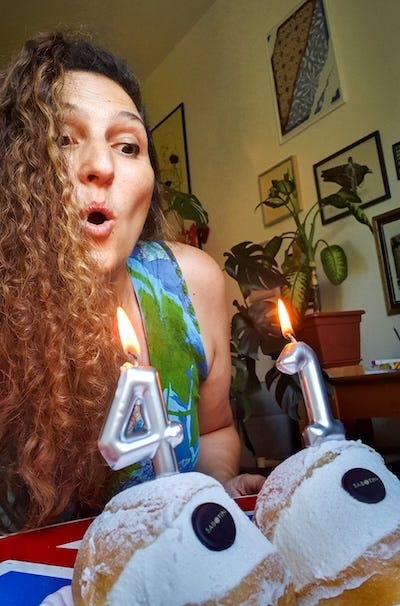
Ciao,
how are you?
I’m drafting this month’s newsletter from my grandma’s place in the countryside, the idyllic garden where I spent all my childhood summers. If this summer dispatch were a voice message sent to you via WhatsApp, you’d hear, over a baseline of cicadas, persistent and almost hypnotic, the bray of the neighbor’s donkey, the wind rustling through the oak leaves, and my grandma shouting that dinner is ready, where am I?
I came here to spend some time with her, but also because I’d had a couple of rough weeks in Rome, juggling two different client projects while wrapping up the London street art book. Unsurprisingly, the combo of final-rush stress and extreme heat wasn’t doing me any good.
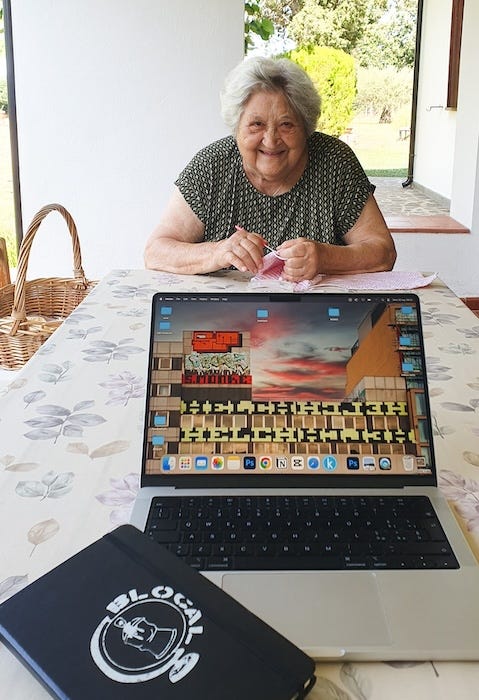
I’m still working while I’m here, but the temperatures are more bearable, and there are more ‘small things’ and ‘little moments’ to pay attention to, things that help keep me grounded. (Can’t say I’ve managed to avoid spiraling the whole time, but I’ve done a decent job for the most part.)
Amidst all the stress, this month brought moments of joy too, especially when thoughtful blurbs for the London book started coming in. I was genuinely moved. These are people whose work I’ve long admired, and receiving their support at this stage feels both uplifting and humbling.
Since this is a self-published project, there’s no publisher, no marketing team, no institutional support…just me, embracing a DIY mentality and facing all the challenges that come with working independently.
That’s why this kind of encouragement means so much. It’s a reminder that even outside the traditional system, you’re never truly alone. There’s a community of people who care deeply about street art and are willing to support each other’s efforts to document and share it.
Here’s just one of those blurbs (I’ll share more over the coming months). It comes from someone I’ve always looked up to, someone I consider a mentor, and who’s been leading the way since the early 2000s.
“I’ve met, curated, and worked with literally hundreds of street artists over the last 25 years. And for every artist, there’s been a handful of supporting actors, bloggers, photographers, writers, academics, journalists, filmmakers, vloggers, the list goes on. People caught up in the passion and revolutionary potential of a democratised public art form, where individuals from all walks of life have the opportunity to stake their place in a movement that offers alternatives to the traditional networks of power that define and shape a city, and, by extension, the people who inhabit and move through it.
The same can be said of specialised fields, including publishing, hence the surfeit of cash-grab “street art” books, often produced with little knowledge of the scene, designed as city guides offering tourists a “splash of colour.”
But this, this book, is different. This is a book with heart, from the soul, written by an author who recognises the core tenets of what makes “street art” such a powerful movement and medium. It wrestles back that which is in constant danger of being lost. Giulia has been a mainstay in the culture for over a decade, and it’s been an honour to witness how the culture has shaped her as much as her research and writing, in turn, have helped shape us.
Buy it, read it, reflect on it. This is street art.”
Martyn Reed, Founder Nuart Festival
This text means the world to me. In fact, all six blurbs do. I’ve already printed them and hung them in the corner of my living room that doubles as my home office, so I can glance at them whenever impostor syndrome starts sabotaging my work, every time I feel like a failure, or when procrastination kicks in because I’m afraid to put something out there, to reach out, to just do the damn thing.
Next step: I’ll print the encouraging words you wrote to me in the Beyond the Walls reader survey (there’s still time to fill it in, if you haven’t yet). I’m even thinking of turning them into a collage, something creative, something to hold onto.
Until next month—or sooner, if the print tests from this week come through and the book is ready to launch 🤞
Giulia
ps. This launch also affects the timing of the London street art trip. I’m really sorry I haven’t been able to announce exact dates yet, I know many of you need to plan flights and accommodation, and I understand how frustrating that is. Unfortunately, it’s out of our hands at the moment.
But as soon as we have a date for the book party, we’ll get to work on a full calendar of street art trips running all the way through spring 2026. Promise!
🎥 New on Youtube!
Behind the Scenes of WOOL, Portugal's first urban art festival.
✍️ New on the blog!
A City in Dialogue: Inside WOOL 2025
I’ve written before about Covilhã, and about why WOOL Festival has earned its place among Europe’s most respected street art festivals.
Last year, I arrived after the artists had already packed up their ladders and emptied their paint cans. The murals were still fresh, but the process, the heartbeat of the event, had already passed.
This time, however, I was there on day one a.k.a. the Recognition, as the organizers call it. This precious first day of the festival is more than orientation. It’s not about choosing walls or mapping logistics. It’s about tuning in, listening to the land, and getting to know the rhythm of the city before making any mark on it.
Polished, Branded, and Safe: The Fate of Street Art in London.
For those of us who came of age in the 1990s, London felt like the future. It was fast, edgy, unpredictable. Ideas landed there before they reached the rest of Europe. Music, fashion, culture, it all seemed to converge and mutate on London’s streets, offering a glimpse of what the world might look like next.
And maybe it still does. But if London continues to point toward the future, it also sends a warning, especially when it comes to urban creativity. Because the future that’s already unfolding on London’s streets doesn’t look great.
When I spent a summer there last year, researching for my upcoming book on London street art, I often stumbled upon polish, urban decoration instead of experimentation and spontaneity. Once the cradle of Europe’s countercultures, London has become a city where creativity is managed, branded, and sold.
The Beautiful Lie of the Creative City.
Over the past two decades, London has been reshaped by a particular idea of urban development. Public squares have turned into shopping centers, old warehouses into luxury flats, streets into corridors of surveillance and controlled access. What looks like public space often isn’t. Much of it is what urban planners call POPS: privately owned public spaces, where behaviour is regulated and spontaneity is discouraged, all under heavy CCTV surveillance.
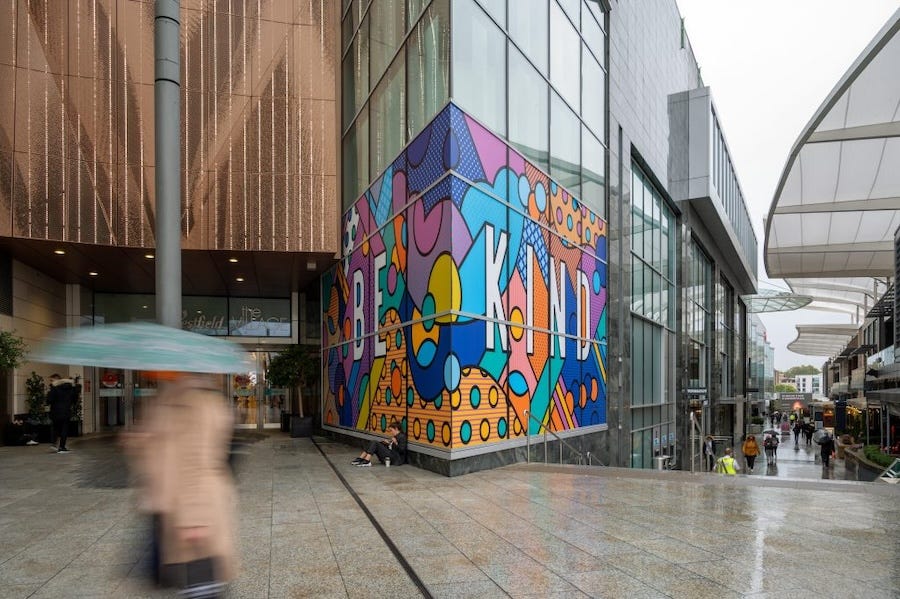
Within this controlled environment, street art has undergone a transformation. The raw, uninvited, and ephemeral gestures that once animated London’s walls have largely disappeared. In their place, we find large-scale, commissioned murals: clean, polished, and perfectly aligned with their surroundings. These works are big, bold, and beautifully executed, but they don’t challenge anything. They blend in. They behave.
In many cases, these murals function more like set dressing than public art: stylised visuals designed to give character to a new development, or colour to a corporate plaza. They’re dropped in like design elements, meant to add just enough “edge” to a place without actually making it uncomfortable.
Artwashing VS Authenticity
What I saw in London is street art repurposed as a branding tool, used to sell a lifestyle, a neighbourhood, or a corporate image. Murals have become a way to make redevelopment look cool and edgy. Developers and marketing teams love to talk about “creativity,” but what they really want is a version of it that’s easy to digest, Instagrammable, predictable, and safe.
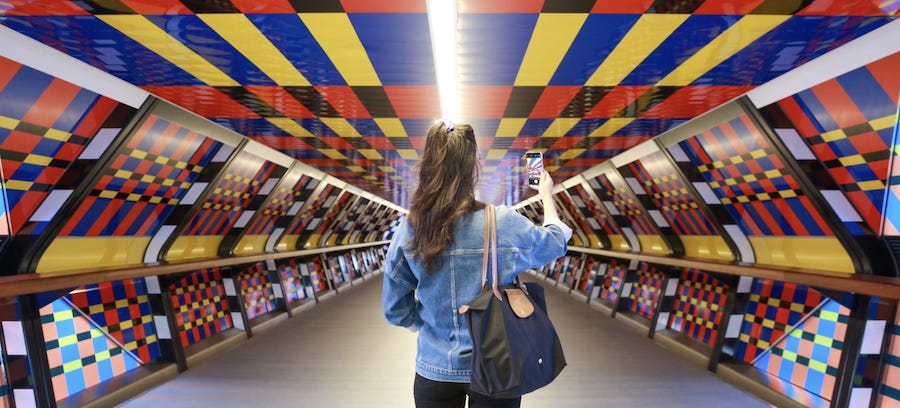
Street art becomes a layer of paint over gentrification: a mural goes up, and the real changes happening behind it (displacement, exclusion, surveillance) are pushed out of sight.

And yet, as highlighted by Rafael Schacter in his latest book “Monumental Graffiti,” the language used around these artworks still borrows from the old narratives. We’re told they’re “authentic,” “rebellious,” even “disruptive.” But in reality, they often do the opposite: they smooth things over, decorate the surface, and leave no room for critique.
What we’re left with is a strange contradiction: art that looks rebellious but is actually reinforcing the status quo. Murals that claim to represent the street, but are designed to make it more profitable. A façade of creativity, sold as evidence that a place is still “authentic,” even when it’s been completely remade.
London didn’t invent this model, but it’s become a textbook example of how easily street art can be absorbed into the machinery of urban branding. A city that once felt unruly and unpredictable has learned to manage its creativity, to clean it up, scale it up, and make it work for property developers. A creativity that sells, not one that shakes things up.
If London still points to what’s next, it’s up to us to decide whether we follow that direction, or find another way.
P.S. Not everything is corrupted or lost. In my upcoming book on London street art, you’ll find many examples of what truly good artworks are, and what they do. Authentic street art, for real this time.
P.P.S An editorial from the past that still feels like a good reason to stay optimistic.

I rely on the support of readers like you to keep creating genuine and informative content. If you value my work and would like to see more of it, please consider making a donation to support my writing and my editorial project BLocal.
You can Buy me Pizzas, Donate via Paypal, or become a Paid Subscriber.
You can also buy my book, As Seen on the Street of Paris, “like” my newsletters by tapping the ❤️, share them on Substack Notes or other social media, and forward this email to anyone you like.
I feel the same about London - most of the new pieces are polished and mostly they are nice portraits of woman or animal, nothing to argue or discuss about. The good thing is that if you look hardly, you still find valuable works, even they won’t have size of mural. Really can’t wait for your London book, this time I’m planning to buy it… there! :) Take care Giulia, a lot of support for you from Lodz xxx
This was such an interesting and painfully resonant read. London used to be the city I dreamed of ending up in. When I finally returned in 2023 after nearly twenty years, it felt like walking through a movie set of itself — especially in Camden. Polished, themed, flattened. Coming straight from Bristol, it hit even harder: how something once raw and full of tension can now feel like packaging.
There’s a strange kind of grief in watching street art become branding — when you still remember it as rupture. This piece puts that discomfort into words with clarity — and makes you wonder how many cities are quietly being streamlined the same way.
Marrakech, the city I actually ended up in, changed the way I look at street art. It’s not really known for it. No big names, no large-scale murals, no hype. The only pieces that get commissioned are for riads or restaurants. And yet, it feels more rooted. If you stop expecting size or polish, a whole visual language emerges — fragile, fleeting, but full of meaning. Marrakech made me question what counts as street art, and who gets to decide that.