


👋 Ciao, I’m Giulia Blocal, your street art insider. This is Beyond the Walls, a monthly deep dive into street art, graffiti, off-the-beaten-path travel, and a bit of my life in between.
This month’s editorial explores AI-generated street art, starting from the case of London’s Christmas mural, which The New Yorker included in its end-of-the-year article “The Year in Slop,” written by Kyle Chayka. (However, the first to explore this case here on Substack were Dr Victoria Powell and Jim Waterson, so do check out their earlier reflections too.)
But first, a few updates on my life and the BLocal project.
Let’s jump in!
Happy New Year, my friends!
If this email finds you still half-wrapped in a blanket, moving slowly through the quiet haze between last year and the next, then it’s landing exactly where it should.
There’s something about this particular pocket of time that always draws me in. A soft pause where ideas can breathe before they’re put to the test, and where I find space to look back, dream forward, and figure out how to move through the year with a little more intention.
One of the brightest moments this month was welcoming some of you to the city we call home. After exploring other cities together, wandering through Rome with you made it feel both deeply familiar and entirely new.
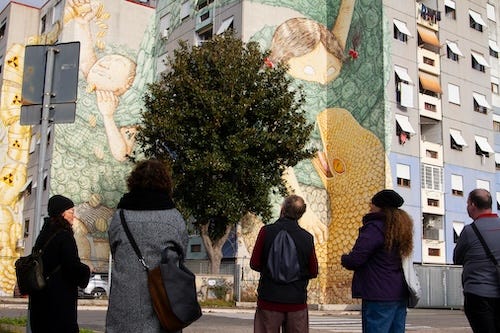
As always, these urban walks we host aren’t just casual strolls. They are the heartbeat of our independent book series As Seen on the Streets of… They help fund the project and give us the chance to gather the images that later find their way onto the pages of the book.
Standing between what has just unfolded and what is still undefined is exactly what this time of year is about. This is the moment when I start thinking about who I want to be in the months ahead. Not in terms of drastic change, but in alignment: how I spend my time, what I commit to, and what I gently let go of.
And like every January, I’m sharing those intentions with you here, because sometimes just having someone else know what you’re trying to build is enough to keep you going.
💪 So, this is what I’ll be working towards in 2026:
✨ To bring As Seen on the Streets of Lisbon to life, with full commitment, thoughtfully, and with the care it deserves. If everything lines up, I’d love for you to be holding your copy by September.
✨ To have a cozy booth at a couple of art book fairs, the kind that focus on street art, graffiti, independent publishing, and zines.
✨ To organise a self-led book tour across the UK for As Seen on the Streets of London, moving from city to city, meeting readers along the way, and letting the book find its people on the road.
✨ To travel again with you, exploring street art scenes together in different cities. I’d love to host four street art trips over the course of 2026.
✨ And finally, the biggest challenge of all: spending a couple of months living in Brooklyn, returning to the roots of the Be Local project. Walking, watching, listening, and letting everyday life in a city shape my writing again.
This yearly ritual of sharing my intentions with you is something I genuinely treasure, especially because it has turned a personal practice into a shared one. Every January, some of you write back with your own goals, your own priorities, your own versions of “this is what I want to build.” When that happens, we make a simple pact: to check in with each other during the year, to see how things are unfolding, to encourage progress, and to acknowledge when plans shift or evolve.
Over time, this has created something rare and meaningful, and so, once again, I’m opening the invitation. If you feel like it, hit reply and tell me what you’re working toward in 2026. Big ambitions, small steps, messy drafts, or loose ideas are all welcome.
We’ll keep each other accountable, in a human and honest way. I can’t wait to root for you. 🥳
With warmth,
Giulia
✈️ Travel with me!
Our next street art trip is happening in April (16th - 20th), and we’ll be heading to London!
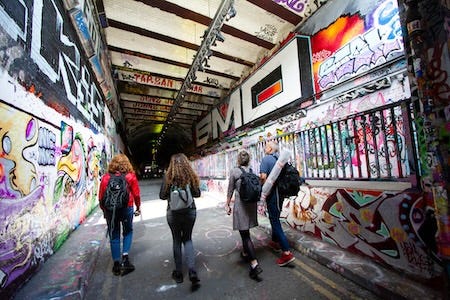
Expect urban exploration, artist encounters, and a special book launch night for As Seen on the Streets of London. 🥳 Spots are limited, so drop me a message or reply to this email if you'd like to come along.
📗 Updates on our book As Seen on the Streets of London
From yesterday, the paperback is officially available in bookshops worldwide, both in physical stores and through online retailers. This means that if you prefer buying from your local bookshop, they can now order it for you. 🥳
As I mentioned in my London vlog, the book has found its London home at Camden Open Air Gallery, a young gallery specialising in urban art. This is where the book signing will take place on April 17th (save the date!), with some of the artists featured in the book joining to sign your copy. 😉 It is also where you can already find the book in stock, no waiting, no ordering required.
Of course, you can still purchase the book directly through me online, which remains the best option when it comes to print quality.
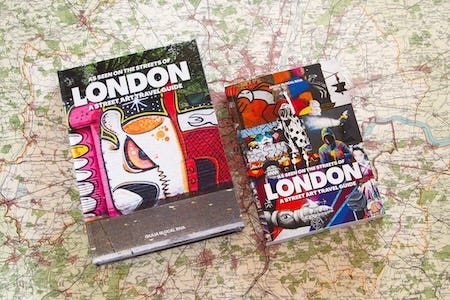
The book continues to receive enthusiastic reviews from journalists working across street art as well as travel and London-focused media. 🥰
Below you’ll find links to the latest articles I haven’t shared with you yet:
Matt Brown on Londonist - “London’s Street Art Culture Celebrated in Astonishing New Book”
Tabish Khan on Londonist: Urban Palette - “The Story of London Trough Street Art”
Inspiring City [podcast] - “Giulia Blocal’s As Seen on the Streets of London”
SKY TG24 - “30 Libri di Viaggio da Regalare a Natale”
Collater.al - “Libri che consigliamo”
London’s Nightmarish Christmas Mural shows what happens when AI replaces artists
A large Christmas mural generated using artificial intelligence was installed in southwest London. Intended to evoke a festive winter scene inspired by the work of Pieter Brueghel the Elder, the image instead unsettled viewers with its distorted figures and surreal inconsistencies.
From a distance, it appeared to depict a frozen Thames animated by crowds and winter activity.
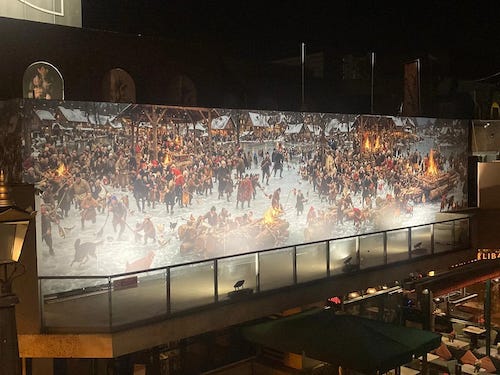
Up close, the image revealed an unsettling accumulation of visual anomalies: grotesquely contorted faces, warped Santa Clauses and snowmen, animals bleeding into one another, and figures with misshapen bodies struggling to skate across shallow, foamy water, while elsewhere crowds packed into an improbably oversized wooden boat.
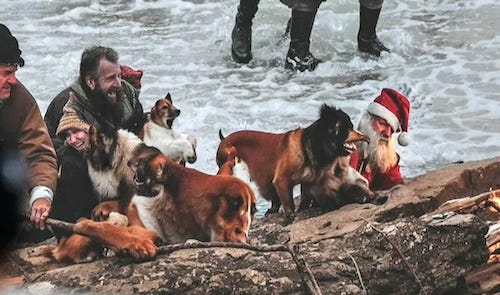
As photos circulated widely on social media, public reaction ranged from mockery to concern, with many questioning how such a visibly flawed and unsettling image was approved for display in a shared urban space.
The Chicago Mural Controversy
Sadly, this AI-generated mural isn’t an isolated case. Earlier this year in Chicago, a public mural sparked significant backlash after it emerged that the artwork was generated by artificial intelligence rather than created by a local artist or through community collaboration.
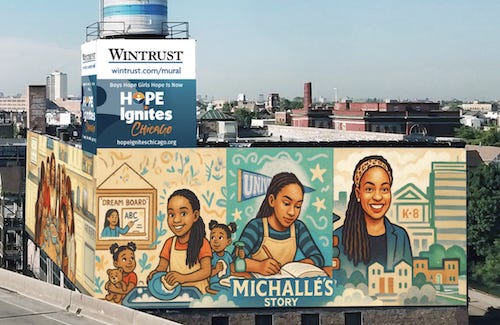
What had been expected to be a celebration of community and culture instead drew criticism as it lacked the authenticity, nuance and human voice typical of murals in the city’s long public-art tradition, while at the same time bypassing opportunities for real artists to contribute to public narrative and place-making.
AI in Public Art: A Question of Representation and Responsibility
Both episodes have sparked broader conversation about the role of AI in public art, authenticity in representation, and how decisions about mural production should involve community voices rather than defaulting to automated tools.
I found images online of the slogan “Hire real artists” spray-painted over other examples of AI-generated urban art, an understandable and legitimate reaction that speaks to a deeper unease about how generative AI is being deployed in public contexts.
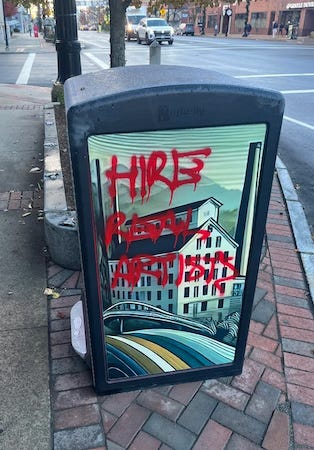
The criticism is not simply a rejection of technology, but a response to processes that replace human labour, authorship, and community work with automated image production. In street art, the role of the artist extends beyond producing an image: it involves research, intention, dialogue with the community, analysis of the context, vision, and accountability.
Street art is not just a visual outcome but a human practice rooted in decision-making, context and lived experience.
With AI-generated works, instead, the result feels disconnected, hollow or careless, reinforcing the perception that speed and cost have been prioritised over meaning and craft.
🤔 But What If the Distorted Christmas Mural Was Intentional?
Today’s AI is far too advanced to produce such blatant hallucinations by accident, and that is what makes those bizarre visuals feel to me intentional rather than careless. I read the accumulation of errors, distortions and surreal mismatches less like a technical failure and more like a provocation, one designed to force viewers to confront the role of the artist, or the absence of one.
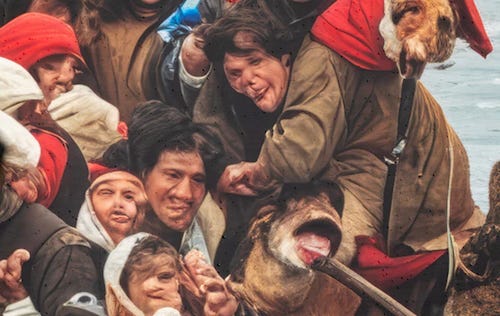
While researching, I came across a persistent rumour attributing the mural to Mat Collishaw, a YBA artist known for his long-standing interest in provocation and, more recently, for his extensive use of AI as an artistic tool. That connection is what fuelled the speculation in the first place. Although no confirmation ever arrived and the artist did not respond to multiple requests for comment, the idea remains compelling. At the very least, it suggests the possibility that an artist deliberately amplified AI’s visual hallucinations to trigger a debate about authorship, intention and responsibility in public space.
This reading feels to me more convincing than the alternative explanation of an unsupervised intern, a rushed approval process and a 100-foot image installed without anyone noticing that something was fundamentally off.
What remains difficult to understand for me is why no one has stepped forward to explain that the mural may have been made on purpose, a silence that ultimately weakens its potential to be read as a deliberate artistic gesture rather than a simple oversight.
If that were the case, then the outrage, confusion and discussion it generated, culminating in the mural being torn down shortly after installation, should be seen not as failures but as outcomes.
After all, this is exactly what meaningful art has always done: unsettle, provoke, invite interpretation, and push us to question how images are made, who makes them, and why.
🔄 Updated!
I’ve added Banksy’s Christmas pieces to my blogpost on all of Banksy’s works in London, exploring where to find them and the meanings behind each artwork.
I’ve added new art galleries discovered during my latest London trip to my blogpost about street art galleries in London.
I rely on the support of readers like you to keep creating genuine and informative content. If you value my work and would like to see more of it, please consider making a donation to support my writing and my editorial project BLocal.
You can Buy me Pizzas, Donate via Paypal, or become a Paid Subscriber.
You can also buy my books, As Seen on the Streets of London & As Seen on the Street of Paris,“like” my newsletters by tapping the ❤️, share them on Substack Notes or other social media, and forward this email to anyone you like.
Do you know someone who might enjoy this newsletter? Invite them to subscribe and win free months of the paid plan. 🎁
Invite a friend right away using this link or the button below.
The silence may be the most interesting part, but I’m not sure it tells us much. An artist can choose not to explain; the people who put the work there can simply say nothing. From the pavement, those two silences look exactly the same.
Even if the distortions were deliberate, there’s still a separate public-space question: not just who made it, but who decided it belonged there. AI can blur authorship. It needn’t blur responsibility.
Maybe I missed something, but when you say generated by AI, you mean it was created with prompts through AI image generation program like midjourney? And the actual mural is printed out and then glued to the wall?
I think all AI generated art is just copyright theft. What else could it be?
But I also think it doesn’t matter. AI well probably destroy the business of real human created public art and illustration. Even things like advertising photography. Because most people don’t care or even see the difference.
What will remain is the things created for the love of it.
And if you don’t know about it, if you ever do make it to Brooklyn for a few months, make sure you take a train down to Philadelphia and see some of the thousands of murals in that town. I spent days there looking at them, and saw just a fraction.