


👋 Ciao, I'm Giulia Blocal, your street art insider. This is Beyond the Walls, a monthly deep dive into street art, graffiti, off-the-beaten-path travel, and a bit of my life in between.
To celebrate this newsletter’s birthday, which began back in September 2014, I’ve decided to double the publications: alongside the usual editorial on the 1st of the month, I’m introducing a new travel column. ✈️
Each month, Beyond the Postcards will take us to a different city, exploring its street art scene as well as many other alternative and off-the-beaten-path places you won’t find in guidebooks (unless it’s one of mine 😉).
The first edition will focus on Lisbon and arrive in your inbox on September 20th. And so, in this newsletter, I want to explore the concept of street art tourism, the thrill of seeking out murals, graffiti, and hidden pieces while discovering a city: why we’re drawn to it, and the tools that make it easier, from blogs and maps to books and guided tours.
But first, a few updates on my life and the BLocal project (📣 I have several announcements to make!)
Let’s jump in!
Ciao,
how are you?
This month I’m writing you from a quiet, tucked-away corner of Sardinia. We couldn’t take a proper holiday this year, as we’ve been completely absorbed in the work for the London book, but at least we get to spend two weeks working remotely just a stone’s throw from the beach.
As for the London book, you might have seen my email last week. If not, check it out below👇 it includes a first look inside the book and some of the lovely reviews it’s already received. 🥰

For now, the London book is only available directly through me.
I’m not sure when it will reach bookshops, so if you’d like to have it in your hands and start leafing through its pages, the best place to get it is right here👇 with me.
(Last week I accidentally sent you the link in Italian, since that’s the version that opens for me. I thought it would switch to your language automatically, but it didn’t… so here are the English links 👆)


Now the plan is to host a book party in London sometime between October and November. However, I won’t be running my urban walks on that occasion, because in November the sun sets at 4 PM in London, which means we wouldn’t have enough light to truly appreciate the artworks or photograph them properly.
😅 (That is, if there’s even any sun in London in November…)
If you’ve joined one of my street art trips before, you know each day is a full-on adventure: packed with art to see, neighbourhoods to explore, artists to meet, and plenty of surprises along the way. Shortening the itinerary would mean losing some of that magic, so I’d rather postpone the London trip to spring 2026, when we can enjoy long evenings in the city.
But do you know where we can enjoy more sunlight (and more time to explore) even in winter? Rome! 😁
For the first time, we’d love to invite you to discover the city we call home. We’ll explore together from December 11 – 15, and as always, each urban walk is independently bookable, so you can join as many or as few as you like, shaping your own schedule.
📤 Reply to this email if you’d like to join!
This trip will form the backbone of the Rome Book. I’ll guide you through my hometown while Paolo captures it with his camera for the next volume in the As Seen on the Streets of… series. By joining, you’ll help us make the book possible, and as a thank-you, you’ll receive a copy once it’s published.
I can’t wait to show you around my hometown,
Giulia
📚 Updates on my book “As Seen on the Streets of Paris”


I finally have a direct link to get the Paris Book, which means no wholesaler in between and a better price for readers in the UK and USA.
If you live somewhere else, you can still order it through Le Grand Jeu website.
..or take inspiration from Anne Thomas, who picked up her copy at Le Grand Jeu’s bookshop in Paris and started using it right away, adding off-the-beaten-path stops to her trip and following local street artists’ tips to discover a different side of Paris.
🥰 Here’s her report:

Why I Travel for Street Art (and Why You Do Too)
This editorial began with a chat I had with Jeffrey Ian Ross, the author of the Routledge Handbook of Graffiti and Street Art and many other texts on the subject.

While exchanging ideas for his piece, I realized that after 11 years of writing monthly editorials on street art and graffiti, I had never tackled the subject of street art tourism, even though it’s what I live and breathe every day.
“Street Art Tourism” can mean many different things. Too often it risks being reduced to a checklist of murals or a spectacle for the tourist gaze, a way of consuming walls without engaging with the voices behind them.
The term itself is loaded, because it can easily slip into contradiction: transforming a practice rooted in illegality, dissent, and spontaneity into a neatly packaged experience for visitors. In this way, an industry has emerged that sometimes strips works of their rawness and re-presents them as entertainment. Practices born out of resistance and marginality can quickly be neutralized when they’re turned into attractions.
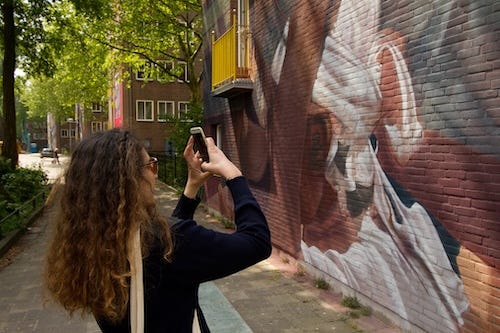
That’s not the story I want to tell.
For me, traveling for street art has always been about something deeper. I see urban art as the perfect way to peel back a city’s layers, and reading its walls has shaped my own urban research — in short, it’s why I’ve been doing this since launching the BLocal blog in 2011.
Perhaps I never addressed the topic because I assumed it was obvious to you, the readers of this newsletter. Many of you subscribed in exchange for my free Google maps of Europe’s street art cities, which means you were already searching for murals, stencils, and pieces before stumbling upon my work. Yet the reader survey showed me how varied your motivations can be: some of you are photographers capturing the city’s rawest edges; others are travelers using graffiti as a compass to explore less-touristy sides of a city; and a few of you are even insiders yourselves, from artists to local tour leaders.
What keeps me drawn to art in the streets is its ability to engage critically with civic life, to spark a dialogue in public space. That’s the spirit behind my blog, as I put it on the homepage:
I believe urban art is something that underlies what our eyes see every day, and by learning about it, you’ll get a more rewarding experience of public space -an experience that is active rather than passive.
From Maps to Books: 50 Shades of Street Art Tourism.
Street art tourism isn’t just one thing; there are many ways to experience it, each offering a different lens on the city.
Over the years, I’ve explored several approaches through BLocal: sometimes with maps and articles, other times with tours, trips, books, or these very editorials. Each of them offers a distinct way to decode the walls and the stories they hold.
What I aim for is to go beyond the “checklist” approach, not treating the streets as a backdrop for Instagram photos, but as a space to engage with critically, reflectively, and in dialogue with the people who shape them.
Self-guided walks
When I publish an article or create a Google map, I’m not just pointing out works to see; I’m giving you a tool to build your own journey. These resources give you the freedom to set your pace, to get lost, and to notice the small details that make a city’s street art scene unique.
Self-guided walks resist the packaging of “streetness1” as a ready-made product, leaving space for chance encounters and personal discoveries.
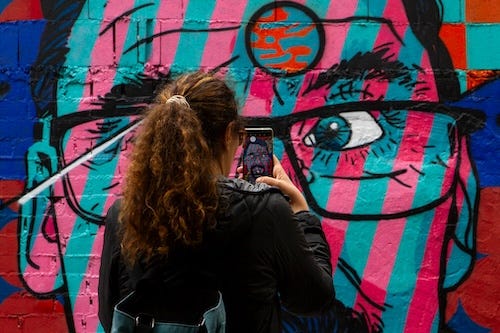
Following your own path also keeps alive what’s central to graffiti and street art: unpredictability. Unlike curated routes that freeze the city into a series of stops, wandering with a map in hand lets you stumble upon the ephemeral, the half-erased, the marginal, the fleeting interventions that rarely make it into brochures but carry the pulse of a city.
Walking together
In Rome, my hometown, I lead private tours that are always shaped by the people who join me. Unlike standardized tours that risk turning street art into a packaged attraction, my walks aren’t about following a fixed route. They are conversations that decide where we go and what we notice.
Instead of reproducing the tourist gaze, we can slow down, reflect, and engage critically with the streets together.
In this way, I try to counteract the risk of tours becoming a parade of murals staged for spectacle. Street art wasn’t made to be consumed as decoration, and if we only stop for the Instagrammable walls, we miss its critical edge.
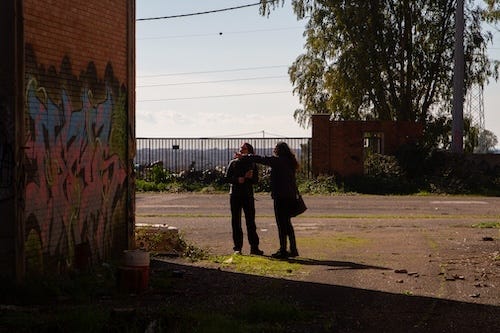
Many mainstream tours end up reproducing that tourist gaze: walking through neighborhoods as if they were museums, consuming “authenticity” while overlooking the lived realities of residents and artists.
My approach is slower and dialogical, not about presenting a finished narrative but about inviting questions on what we see and why it matters. This way, I can guide your gaze toward the overlooked and the raw: human-scale interventions, unsanctioned works, and pieces that might otherwise be overshadowed by flashy murals.
My aim is not only to share knowledge but to leave you with tools you can carry forward, so you can decode the walls in your own future explorations.
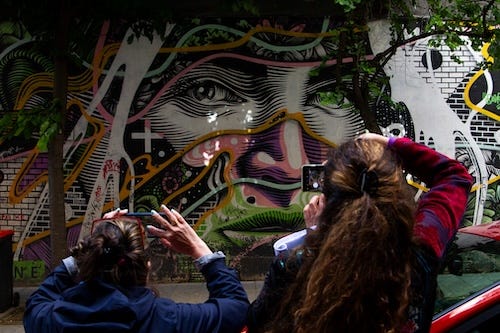
Beyond Rome, I also organize group trips to other European cities, where discovery happens collectively, enriched by the mix of perspectives from passionate admirers and hunters to professional photographers, each bringing their own way of seeing the streets. Group discovery also resists the isolated tourist gaze: instead of individuals consuming a neighborhood as outsiders, the shared reflections make the city less of a backdrop and more of a lived, contested space.
The monthly newsletter “Beyond the Walls”
These editorials are another tool, a space to reflect on how graffiti and street art reshape our cities, from gentrification and disneyfication to questions of copyright, documentation, and the digital age.
They are less about cataloguing artworks and more about examining the issues they raise. Too often, tours and guides focus on spectacle while avoiding difficult questions about ownership, erasure, or the ways urban art is used in gentrification and city branding.
These editorials are meant to keep those tensions visible, because street art tourism should spark debate as much as admiration.
Tourism often edits out the messier aspects of graffiti: its illegality, its conflicts, its political edge. Through these texts, I try to hold space for those aspects too, to remind us that what we call “street art” is part of wider struggles over who owns the city and who gets to speak on its walls.
In a field where urban art is often sanitized for easier consumption, whether as branding or as lifestyle content, I see this newsletter as a reminder that the streets remain political and that their tensions should not be smoothed out. The city’s walls are not decoration; they are contested territory.
The book series “As Seen on the Streets of…”
My self-published books go deeper still. Blending research, photography, and conversations with local artists, they invite readers to see cities through the eyes of those who paint them, uncovering overlooked corners and stories often missing from mainstream narratives.
Each book is meant as both a document and a companion, a way to read the city actively and explore beyond the beaten path at your own pace. Rather than flattening the city into a marketable image, the books hold onto the contradictions of urban art: its illegality, its ephemerality, its tension with institutions and property. They do not sanitize, they amplify the voices that mainstream narratives often leave out.
These books also confront how urban creativity intersects with urban change: how murals can attract cultural capital, how graffiti gets erased in cycles of regeneration, how artists themselves are caught between visibility and exploitation. To understand street art without these dynamics would be to misread the city entirely.
There are plenty of books that present street art as a catalog of murals, detached from their context. My books resist that temptation: they document the friction as much as the beauty, the temporary as much as the monumental. They ask readers to look at what is not usually framed: the overlooked, the contested, the fragile traces of a culture always at risk of being erased or appropriated.

The Purpose of Street Art Tourism
In the end, all these different shades of street art tourism — maps, tours, trips, books, editorials — serve the same purpose: to make the city legible through its walls. This has always been the mission behind BLocal: to bridge the gap between urban art and the general public, and to foster a more active, engaged relationship with public space.
For me, it is never enough to stop at a colorful wall, or worse, to turn it into spectacle. The challenge I set for myself through writing, guiding, or publishing is to invite deeper reflection on context, meaning, and impact.
Whether through an article, a book, or an interactive tour that sparks discussion, my goal is to encourage a more thoughtful way of experiencing street art, one that speaks to the curiosity of hunters, the eye of photographers, the passion of practitioners, and the shared desire to connect more deeply with the environments we inhabit and the voices that shape them.
Street art tourism will always sit in a tension between appreciation and commodification, between learning and consuming. I do not claim to solve this contradiction, but I try to face it head on with tours, books, and articles that insist on context, voices, and criticality. Because if we ignore that tension, we risk turning resistance into merchandise and walls into wallpaper.
Street art tourism should never become just another product to be consumed. It should not market neighborhoods as edgy backdrops for Instagram photos, or flatten dissent into spectacle.
For me, its purpose is different: to build a more critical and engaged relationship with the city, to hear the voices of artists on their own terms, and to see walls not as decoration but as spaces of dialogue, conflict, and possibility. Its real potential lies in sharpening our awareness of the politics of public space, reminding us that every tag, mural, or stencil is part of an ongoing conversation, not a commodity
I rely on the support of readers like you to keep creating genuine and informative content. If you value my work and would like to see more of it, please consider making a donation to support my writing and my editorial project BLocal.
You can Buy me Pizzas, Donate via Paypal, or become a Paid Subscriber.
You can also buy my books, As Seen on the Streets of London & As Seen on the Street of Paris,“like” my newsletters by tapping the ❤️, share them on Substack Notes or other social media, and forward this email to anyone you like.
I first came across the term streetness in Sabina Andron’s Urban Surfaces, Graffiti, and the Right to the City (Routledge, 2024)
I love the idea of street art tourism! We are visiting Penang, in Malaysia, which has superb murals and street art, depicting local scenes, and I'm going to write a post about it in a couple of weeks :)
Absolutely love this! Moving to Paris opened my eyes to street art in a whole new way. I’m visiting Nice later this summer to go swimming, and am curious what I’ll find.